Introduction
Trigonometric equations and inequalities are a fundamental component of AP Precalculus, specifically under Topic 3.10. These problems require you to manipulate trigonometric functions—sine, cosine, and tangent—while leveraging their periodic properties, symmetry, and the unit circle. The worksheets provided (A, B, C, and D by Bryan Passwater) present a variety of challenges: solving equations for exact values over the interval  , finding points of intersection between functions, and determining intervals where inequalities hold. This blog post is a detailed, self-contained guide to mastering these concepts, complete with step-by-step explanations, solved examples and we have another detailed blog dedicated to the resources where we enlisted Top 10 books for AP Precalculus.
Trigonometric Functions and the Unit Circle
Before we tackle problem-solving, let’s establish the foundation. The sine, cosine, and tangent functions are defined on the unit circle, a circle with radius 1 centered at the origin. For an angle  (in radians):
 represents the y-coordinate of the point on the circle.
 represents the x-coordinate.
 , which is undefined when
  .
.
 represents the y-coordinate of the point on the circle.
 represents the x-coordinate.
 , which is undefined when
  .
.The unit circle repeats every  radians, and within , each function exhibits distinct behavior:
- Sine: Ranges from
 to
to  , positive in Quadrants I and II, negative in III and IV.
 - Cosine: Ranges from to , positive in Quadrants I and IV, negative in II and III.
- Tangent: Ranges from
 to
to  , positive in Quadrants I and III, negative in II and IV, undefined at
  and
and  .
.
 to
to  , positive in Quadrants I and II, negative in III and IV.
 to
to  , positive in Quadrants I and III, negative in II and IV, undefined at
  and
and  .
.Key angles and their trigonometric values are critical to memorize:
 ,
,  ,
,  .
. , ,
, ,  .
.- ,
 ,
,  .
.
 ,
,  ,
,  .
. ,
,  ,
,  .
. ,
,  ,
,  .
.Reference angles are used to find solutions across quadrants:
- Quadrant I:
 .
. - Quadrant II:
 .
. - Quadrant III: .
- Quadrant IV:
 .
.
 .
. .
. .
. .
.Solving Basic Trigonometric Equations
Let’s begin with simple equations of the form  ,
,  , or
, or  .
.
Example 1: Solve the equation  for all solutions in :
- Step 1: Identify where sine equals the value. We need
 . From the unit circle, , so the reference angle is .
 - Step 2: Determine quadrants. Sine is positive in Quadrants I and II.
- Step 3: Find solutions.
- Quadrant I:
 .
. - Quadrant II:
 .
.
- Quadrant I:
- Step 4: Verify interval. Both and are within .
 .
. .
. .
. are within
 Solutions:  .
.
Example 2: Solve the equation  for all solutions in :
- Step 1: Reference angle. We need
 . Since , the reference angle is .
 - Step 2: Quadrants. Tangent is negative in Quadrants II and IV.
- Step 3: Solutions.
- Quadrant II:
 .
. - Quadrant IV:
 .
.
- Quadrant II:
- Step 4: Check. Both satisfy the interval.
 .
. .
.Solutions:  .
.
Download this free AP Precalculus worksheet with solutions for targeted practice and a better understanding of concepts
Start preparing effectively now!
Linear Trigonometric Equations
Equations with coefficients require algebraic manipulation to isolate the trigonometric function.
Example 3: Solve the equation  for all solutions in :
- Step 1: Isolate cosine.
- Start with
 .
. - Subtract 3:
 .
. - Divide by 2:
 .
.
- Start with
- Step 2: Reference angle. , so the reference angle is .
- Step 3: Quadrants. Cosine is negative in Quadrants II and III.
- Step 4: Solutions.
- Quadrant II: .
- Quadrant III: .
- Quadrant II:
 .
. .
. .
. .
. .
.Solutions:  .
.
Example 4: Solve the equation  for all solutions in :
- Step 1: Isolate sine.
- Start with
 .
. - Subtract
 :
:  .
. - Divide by 2:
 .
.
- Start with
- Step 2: Reference angle. , reference angle is .
- Step 3: Quadrants. Sine is negative in Quadrants III and IV.
- Step 4: Solutions.
- Quadrant III: .
- Quadrant IV: .
- Quadrant III:
 :
:  .
. .
. .
. .
.Solutions:  .
.
Quadratic Trigonometric Equations
Equations with squared terms often resemble quadratics and may require factoring or the use of identities like  .
.
Example 5: Solve the equation  for all solutions in :
- Step 1: Isolate the squared term.
- Start with
 .
. - Subtract 2:
 .
. - Divide by 4:
 .
.
- Start with
- Step 2: Solve for sine.
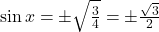
 .
.
- Step 3: Case 1: .
- Quadrants I and II.
- Quadrant I: .
- Quadrant II: .
- Step 4: Case 2: .
- Quadrants III and IV.
- Quadrant III: .
- Quadrant IV:
 .
.
 .
. .
. .
. .
. .
. .
. .
.Solutions:  .
.
Example 6: Solve the equation  for all solutions in :
- Step 1: Form a quadratic.
- Start with
 .
. - Move terms:
 .
.
- Start with
- Step 2: Factor.
- Let
 :
:  .
.  .
. or
or  .
.
- Let
- Step 3: Solve for cosine.
 (impossible, since
  ).
). .
.
- Step 4: Solutions.
- at
 .
.
 .
. :
:  .
. .
. or
or  .
. (impossible, since
  ).
). .
.Solution:  .
.
Points of Intersection
These problems involve setting two functions equal and solving for  .
.
Example 7: Find the -coordinates of the points of intersection of  and
and  in :
in :
Find -coordinates in where and intersect:
- Step 1: Set equal.
 .
.
- Step 2: Solve.
- Subtract 5:
 .
. - Divide by -3: .
- Subtract 5:
- Step 3: Solutions.
- at .
 .
. .
. .
.Solutions:  .
.
Example 8: Find the -coordinates of the points of intersection of  and
and  in :
in :
- Step 1: Set equal.
 .
.
- Step 2: Rearrange.
 .
.
- Step 3: Factor.
 .
.
- Step 4: Solve.
- :
 (note:
  is excluded by
  ).
).  .
.- Quadrant I: .
- Quadrant II: .
- Quadrant I:
 .
. .
. .
. :
:  (note:
  ).
). .
. .
. .
.Solutions: 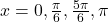 .
.
Trigonometric Inequalities
Inequalities involve determining where a function satisfies a condition, often using the unit circle or sign analysis.
Example 9: Solve the inequality  for all solutions in :
- Step 1: Equality points.
- We need
 .
. - at
 (Quadrant I),
  (Quadrant II).
- We need
- Step 2: Analyze sine’s behavior.
- Sine increases from
 to from to , peaks, then decreases to at , and rises to at .
- Sine increases from
- Step 3: Test intervals.
 :
:  , false.
 :
:  , true.
 :
:  , false.
- Step 4: Include endpoints.
- At and , , satisfying
 .
.
- At
 at
at  (Quadrant I),
  (Quadrant II).
 to
to  :
:  , false.
 :
:  , true.
 :
:  , false.
 ,
,  .
.Solution: ![\theta \in \left[ \frac{\pi}{3}, \frac{2\pi}{3} \right]](/wp-content/ql-cache/quicklatex.com-5a7e387c4b052951b993b28a04242ac2_l3.png "Rendered by QuickLaTeX.com") .
.
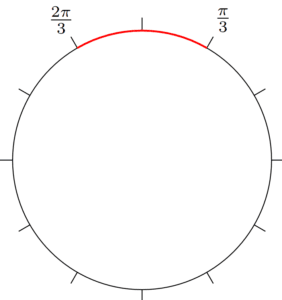
Example 10: Solve the inequality  for all solutions in
 ![[0, 2\pi]](/wp-content/ql-cache/quicklatex.com-dbb0f8663da9b7c9b605f90189c76eea_l3.png "Rendered by QuickLaTeX.com") :
:
Solve for :
- Step 1: Find zeros.
- We need
 .
.  .
. .
.
- We need
- Step 2: Critical points.
 (sort:
  ).
).
- Step 3: Intervals.
 .
.
- Step 4: Sign analysis.
- Test in :
 .
. - Test in :
 .
. - Test in
 :
:  .
. - Test
 in :
in :  .
.
- Test
- Step 5: Solution.
- Negative in and .
- Union: (since makes the product , excluded by
 ).
).
- Negative in
 .
. .
. (sort:
  ).
). .
. in
in  .
. :
:  .
. in
in  :
:  .
. in
in  :
:  .
. (since
  ).
).Solution:  .
.
FAQs About AP Precalculus
As you explore Topic 3.10, you might have questions about AP Precalculus itself. Here are brief answers to two common ones:
Q1: How Hard Is AP Precalculus?
It’s moderately challenging if you’re solid on Algebra II and functions. Topic 3.10 adds trig complexity, but with practice (like the worksheets), it’s manageable—less intense than AP Calculus.
Q2: Does AP Precalculus Give College Credit?
Yes, many colleges offer credit or placement for a 3, 4, or 5 on the exam (3-4 credits), though policies vary. Check your target schools’ AP credit pages.
Need personalized guidance? Book a private online AP Precalculus tutor now!
Keep an eye on the official College Board web page for current information regarding the Exam!